SHR Emblem

SHR Emblem

Tuesday, August 25, 2015

Tuolumne Meadows to Mammoth with Pictures

After getting lost and having a really intense and scary experience on Sky Pilot Col, I took the rest of the day off once I made it to Tuolumne Meadows (Random aside:  The day I arrived was the first day the campground was open after they closed because 2 squirrels died of the plague there).  I relaxes, hung out, and gave my legs a break because they needed it.  I also decided not to continue with the Sierra High Route because it was just over my comfort level being by myself.

What I had experienced three days prior and on two prior off-trial weekend trips was not what I wanted to do.  There were a lot of little reasons (my knees and ankles were getting pretty beat up, the traction on my shoes was essentially worn down, smoke from a fire in Sequoia NP made sighting off the next canyon very difficult at times) but my main reason was because I wasn't enjoying myself.  I found out that a trip like this is something I need to do with at least one other person.  The mental aspect part of the hike wore me down and I didn't want to make bad decisions when I was tired.

This means that I am going to take the John Muir Trail (JMT), and maybe one short manageable section of the Sierra High Route, from Mammoth to Horseshoe Meadows near Lone Pine.  To get to Mammoth, I took a 60 mile half circle that started in Toulumne Meadows, went through Vogelsang area of Yosemite, down to Isberg Pass, and then through the Sierra National Forest to Devil's Postpile National Monument, which is right outside Mammoth.

I chose this route on a whim and it was tough because it was hot and didn't have a lot of running water sources.  I went through parts of Yosemite I had never been through but once I got away from Vogelsang, the trail was pretty boring, especially considering that I was in the Sierra Nevada.

I meet a Canadian couple about a day out from Mammoth and realized how little water there was in the area.  They did their research and found that there was a good chance that we would have only one water sources in the last 20 miles (this ended up not being true but this is how we had to treat the last 20 miles).  As a result, I down 4 liters of water in about 2 hours and then carried the maximum amount of water, only 2 liters.  These 20 miles didn't turn out that bad but it made for an worrisome afternoon, night, and morning.

Once in Mammoth, I took a day and a half off and will be heading back to the trail tomorrow morning for a weeks worth of hiking to Independence.

Yosemite

Vogelsang Area
This is how smokey it has been.  I think that this is of Half Dome.

Add caption


Last for sure water source before Mammoth.  Great place to swim though.

If only the mosquitoes didn't eat me alive here, I might had enjoyed the furniture.

Looking at a view near Mammoth

Red's Meadow!

Twin Lakes to Toulumne Meadows with Pictures (ie getting lost and really scared)

I'm going to post the first six days of my trip is two posts because each of the three day segments were so different and challenging.

On Wednesday (19th of August), a good friend's dad (thanks Hy!) drove me to get my permit at the Bridgeport Ranger Station and then on to the trail head at Twin Lakes.  He dropped me off and I was on my own.  The first day of hiking was very challenging but stated with about 5 miles on trail.  Then I walked up a canyon to Horse Creek Pass.  This was the start of my "off-trail" hiking and it was tough.  Climbing more or less straight up the side of a hill and walking/climbing over talus (rocks that range from the size of a small dog to the size of vans) makes it really tiring and difficult.  After making it up that pass, I descended to through a meadow (one of the best one's I've ever been through) and then went over my second pass of the day.

The only problem was that I went over the wrong one.  I didn't realize this until I got to my camping spot for the night.  After the second pass, I passed by a lake, went for a swim, and climbed up another ridge to camp.  At camp, I realized I wasn't headed in the wrong direction and between an app on my phone and my paper maps, I was able to figure out where exactly I was.

On the second day, I got myself back on my route and spent the morning climbing my third pass of the trip, Sky Pilot Col.  The whole experience of this pass was probably one of the scariest things I had ever done.  Going up the pass was like climbing up a wall that crumbles when you look at it.  The scree (essentially pea sized rocks that make you slide down the hill when you step on them) mixed with talus made it really difficult and dangerous because no hand or foot hold was "safe."  After who knows how long, I made it to the top and then was greeted by a cliff of granite.  This sight scared me more than anything I've EVER done.  I had not idea how I was going to get down because going back the way the came wasn't an option.  After giving myself a really good pep talk that I was going to be fine, I climbed over a small ridge and saw a better, but almost equally steep way down.

Thankfully, I made it down that pass with nothing worse than some rocks in my shoes and the rest of the day was pretty mellow, from the danger point of view.  It was tiring to go up the side of a Mt. Conness but my campsite was prime for Day 2.  I was able to look back at where I came from and was also by a lake.

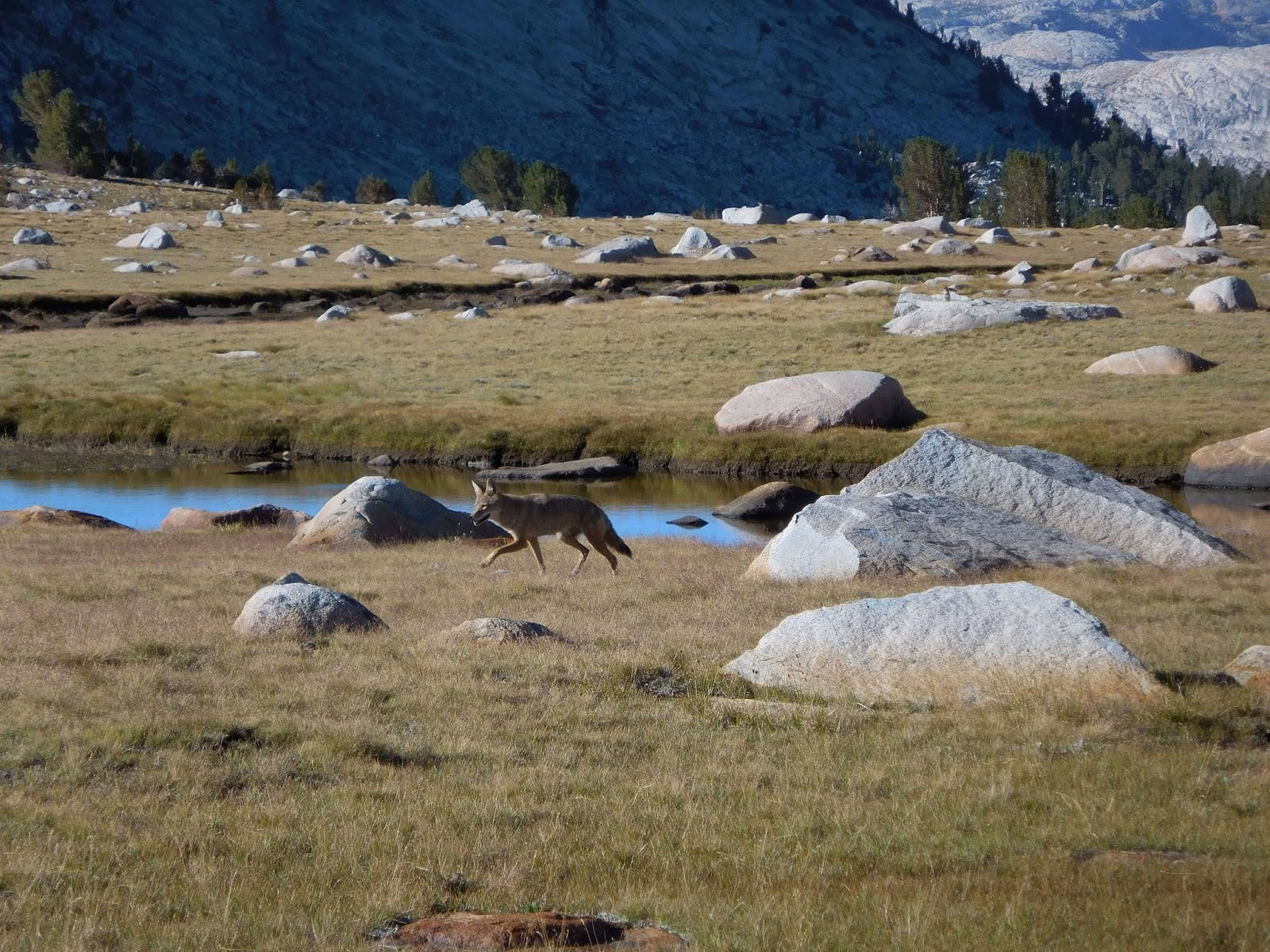
Day 3 brought no passes but just a lot of small ridges to climb and lakes to pass around.  Mid-morning I saw a fox or coyote (I'm not sure what one) and ended up in Toulumne Meadows in Yosemite National Park.  I took the rest of the day off to give my tired and sore knees and ankles a break and to reevaluate of what route through the Sierra I wanted to take.  The Sierra High Route was fun for the first three days, but a little over my comfort level.  I'll explain more in the next post.

Start of hiking again

View of Twin Lakes

Top of the Horse Creek Pass (its the V notch)

Glacier on the side of the pass

View from the top of the pass

Meadow from the first day

Looking back towards Horse Creek Pass
View from my "second" pass.  I went down towards the lake.

View of Sky Pilot Col, the way I went up

View from top of Sky Pilot Col

Campsite from Day 2

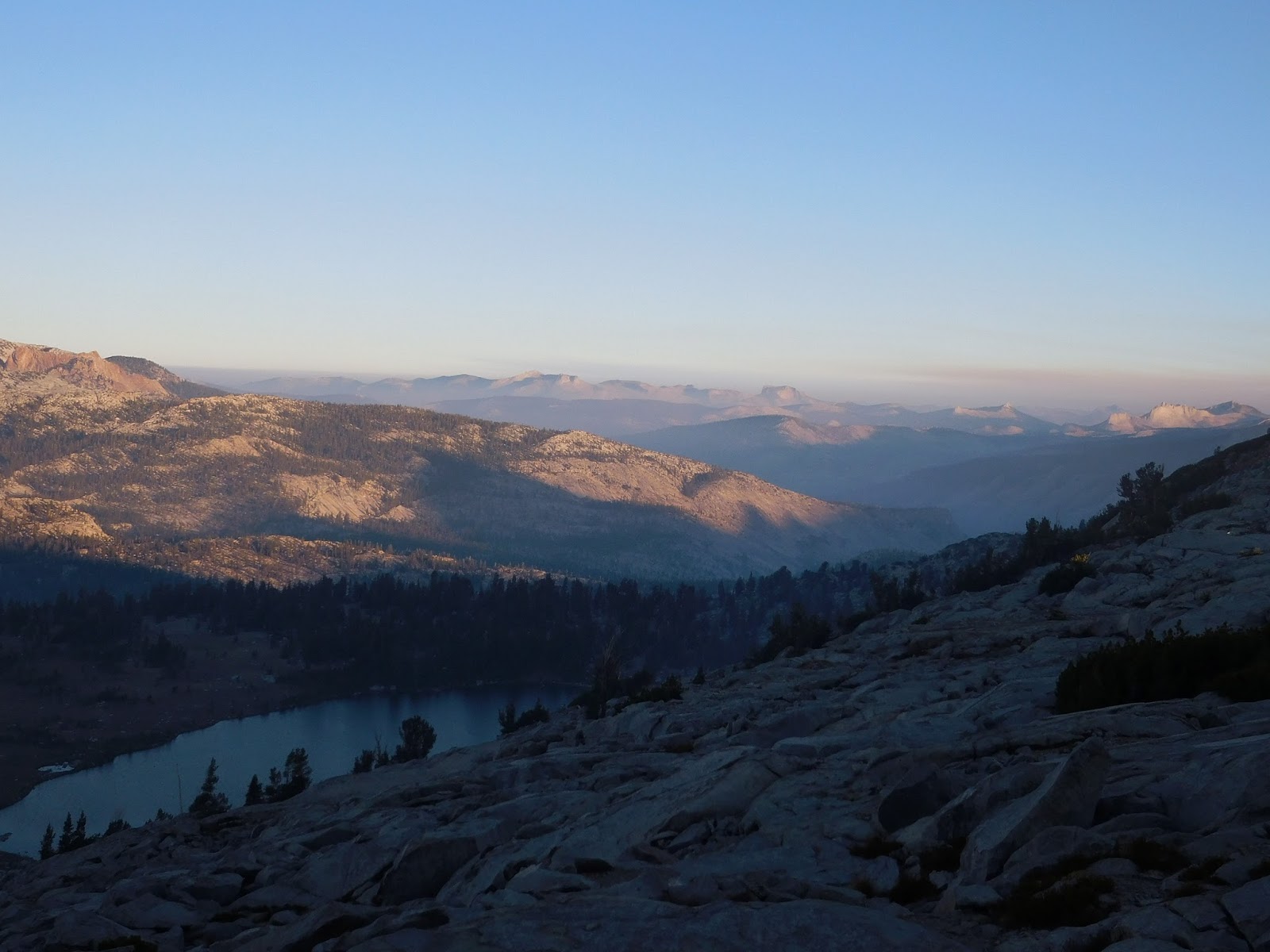
Looking back on where I hiked through on Days 2 and 3

View of Gaylor Lakes

Is it a fox or a coyote?
Yea!  Dan's last day of work.

Tuesday, August 18, 2015

Waiting until the last minute

Tomorrow is my start day for the SHR and I feel like I have been crazily tying up loose ends before I left San Diego and as I made my final adjustments to my pack in Mammoth.  As I finished packing up my stuff in Mammoth, I found that my water filter somehow didn't quite make it into my bag.  I have no idea where the heck it is but more likely than not, it got packed away with my kitchen stuff as I was packing up my room/things yesterday.  This meant a trip to the Mammoth Mountaineering store to get another.

I also had to figure out my emergency contact device because I got my hands on it this evening.  So much for a relaxing night before my hike.

If anyone wants to follow where exaclty I am on this hike check out http://share.findmespot.com/shared/faces/viewspots.jsp?glId=0VYMQQfJLD8MOOhN4YbOQUardJiTM2Jxe
I have a fancy device that pings my position every 10 minutes and puts it on the above website.  I thought it would be a neat thing to do so here's to giving that a try.

Sunday, August 16, 2015

On the Trail Again!

The time is here again for big adventures!  In November, I will be starting nursing school and before starting, I am going to have some more fun in the outdoors by hiking the Sierra High Route (SHR), biking to Montana, and spending some time in North Carolina.  Like a few years ago, I plan on updating this blog at least once per week and sharing what interesting, strange, and fun things happen.  I will post about my biking plans after I get through my SHR hike.

You may not have heard about the SHR, so here is a brief description.  It is an approximately 200 mile trail that runs from Twin Lakes, which is near Bridgeport, CA and the northern border of Yosemite NP, to Land’s End in King’s Canyon National Park.  It is mainly parallels the more well know John Muir Trail but stays at higher elevations, mostly above 10,000 feet.  It runs through pristine high country and places few people go.


To make my trip a little more memorable and scenic, I will hike the northern two-thirds of the SHR and then branch off near Bishop Pass and take the Southern Sierra High Route (SoSHR) and end near Mt. Whitney.  The SoSHR continues along the crest of mountains north of Mt. Whitney to the summit of Mt. Whitney via the Mountaineer’s Route and then onto Cottonwood Lakes.  This portion of the trail is about 100 miles long and continues through parts of the Sierra Nevada that are better than the southern one third of the SHR.


For me, doing the SHR and SoSHR is the next logical step after hiking the Pacific Crest Trail in 2013.  More than two thirds of this trip will be off trail.  This means that I will be in areas that there are few people, not easily accessed, and more beautiful, pristine, and stunning than you find when hiking on a trail in the Sierra Nevada, but it also comes a great deal of risk.  Less people means less of a chance of seeing someone if I have any issues, navigation or injury wise.  Less access and better scenery means that it is more rugged and challenging.  Instead of plugging into my iPod and listening to my favorite podcast during the afternoon, I will be constantly looking at the map and navigating over and through the terrain, getting myself over talus and scree fields (essentially cell phone to truck sized granite that is very physically tedious to go through) and doing the occasional Class 3 scramble (this is where you climb along a rock or on the side of a mountain where there is a large drop below you).  This trail seems so exciting and like a great way to continuously improve my outdoor skills.


To help minimize my risk, I plan on taking a SPOT device.  This will allow me to let my family know that I made to camp and alert search and rescue if I have any unfortunate accidents and cannot hike myself out.  Another great thing is that it will track my progress so you can see where I am in real time (I will post a link for this once I know it).  Because I’m hiking by myself, a SPOT device is the something that will help me be safer on this backpacking trip.


In case you want to read more about the SHR or the SoSHR, here are some websites:

I start on Wednesday and hope to post an update once I get to the Valley in Yosemite!

Sunday, October 6, 2013

The Last Post

This is my last post about my PCT trip.  Some final thoughts, stats, and closing about the last 5 months.  Also as a note to all who read this, I am looking for job as you read this, so if you or anyone you know are interested in hiring me, please send me a message through the blog!

As anyone who has read my blog knows, I left my job in mid-April to try to hike 2660.1 miles from the border of Mexico and the US to Canada.  To get there, I hiked through the desert, Southern California mountains, the Sierra Nevada, near Lake Tahoe, through northern California (which was a cross between the desert and mountains), the Cascades, Oregon, Washington, and then finally the northern Cascades.  As I hiked through Washington, the beginning and middle of my trip seemed so far away.  Almost like it was another trip because the conditions changed so much.  No longer was I carrying 5-7 liters of water with 5-7 days of food in exposed and hot desert, but I was carrying 1-2 liters of water with 3-4 days of food.

It's amazing to think where I've been, who I've met, and how I have handled so many diverse and different environments and people.  One of the cool things of the PCT is that you never know where people you have met on the trail are.  One of the people I met on my first day and saw around mile 600, showed up again around mile 1900.  I was normally the one who seemed to "skip" around on the trail and because of this, I got to see many of the slower hikers again.

I started the trail on May 1st and thought that I could make it.  After just eight days on trail though, I couldn't continue because of two feet full of blistered.  I learned quickly that the PCT was all about taking care of yourself:  making sure you eat enough and balanced, making sure you don't hike to much in one day, making sure you get enough rest, making sure you are emotional well, making sure your body is prepared for the next day.  This was the challenge of the trip that manifested itself all the time.  For someone like me who did much of their hiking alone, making sure I hiked or camped with others was as important as getting the nutrition and calories I needed everyday.

While I sat at home contemplating my blisters and my choices that led me to not being about to walk, I wondered if I would finish the PCT.  2660 miles is a lot but breaking it up into 100 mile chunks made it much easier.  After 5 days of R and R, my feet were ready to hike and I got back on trail.  My blisters and feet issues never completely stopped until I made it into the Sierra Nevada (~mile 800).  It did slowly get better but I wasn't able to hike without moleskin until then.

I soon found out that the Southern California section of my trip was "my tour of friends and family" because I stayed with them almost exclusively throughout my town stops in SoCal.  It was a nice way to still feel connected to my pre-PCT life and help others experience the PCT.

It's funny to think about how challenging SoCal was in the first 6 weeks (blisters, heat, lack of water, skipping a section of trial) but the Sierra Nevada really made SoCal seem like a mental challenge because it was such a physical challenge.  After 2 weeks of climbing mountain passes, summitting Mt. Whitney, and living at 8000 to 13000 feet, my body was adjusted to the rigors of this hike.  The Sierra Nevada made the hiking afterwards easy because the hills were smaller, I was fitter, and I could crank out miles.

This continued until a my shin splints/tendonitis in Etna, Ca where I went home for 10 days.  This was the first time since my blisters that I seriously wondered what was to happen to my trek.  I had seen the spectacular Sierra Nevada, survived the desert, and had almost gotten through the (mostly) boring Northern California when my right upper ankle/lower shin hurt.  I knew I couldn't continue and needed rest, but the question was for how long.

After some much needed R and R (I had spent much of the prior 10 days hiking high 20 mile or low 30 mile days), I got back on trail and made it to Oregon, the third big morale boaster (number one being making it to the Sierra Nevada and number two being making it to Lake Tahoe (ie out of the high Sierra)).

Oregon proved to be flat, a green tunnel, mentally taxing, and harder than I thought.  It was great to see Crater Lake and the big volcanic Cascade mountains, but the weather made it difficult.  After a storm  near the Three Sisters Wilderness, I had my only moment when I really wanted to quit and would of if I could have.  An unplanned stop in Sisters, Or fixed that and I was ready the wetness and weather of the Pacific Northwest.  While I wasn't very excited for any type of precipitation, I found it was the wet plants which would soak my shoes and feet that was my problem in the Pacific Northwest.

I got through Oregon without much more issue and got to Washington right before another huge storm hit.  I took off an extra off-trail day, and then began the final push for the Canadian border.  Because I had never hiked in Washington, I was super excited to be there; however, the first half was very similar to Oregon and boring.  Once I got the Snoqualimie Pass and the northern Cascades, the trail became a lot more fun again.  This trip culminated with a small storm, cold, snow, and barely beating a big storm.  I promised myself that if it snowed on me in Washington that this would end my trip.  While I did get snowed on or hiked in snow 3 out of my last 4 days, I would say that I ended right one time.

I hope everyone enjoyed reading about my adventures and looking at just a few of the over 1000 pictures I took while on the PCT.  It has been one of the best 5 months of my life but also one of the toughest.  Similar to my time living abroad, my PCT trip has changed me and it will take a little time getting use to the "other" world (that is what we hikers refer to the non-hiking world).  I look forward to sleeping inside on a bed and not having to wear my same sweating shirt for days at a time between washing but will miss the amazing mountain water I drank and the simplicity of my life.  Who know where life will take me next, but it will be fun to see.

Random Stats from my trip:

Top Three Trail Towns:  Stehekin, WA; Etna, CA; Mammoth Lakes, CA
Top Three Places on the PCT:  Goat Rocks Wilderness, WA; just south of Sonora Pass, CA; the High
High Sierra Nevada (aka the John Muir Trail)

Number of Books Read: 7 completed and 3 partially read (I'm still working on these)

Number of showers taken: 31 (that's 1 shower for every 4.2 days)

Total Number of PCT Miles Hiked:  2526.7
Total Number of "Other" Miles Hiked (to/from towns, springs, etc): 134.1
Total Number of Miles Hiked:  2392.6

Total Days on Trail: 130
Average Miles per Day:  19.4
Most Miles Done in a Day:  35.9
Least Miles Done in a Day:  4.5
 
Total Number of Nights Slept -    Under the stars:  47
                                                    In tent without rain fly:  35
                                                    In tent with rain fly:  21
                                                    In a bed:  27
                                                    Inside:  26

Total Number of Days with -    Rain:  23
                                                Thunder:  11
                                                Lightning:  5
                                                Hail:  2
                                                Snow:  2

Number of Zero Days:  11
Number of Days taken off trail for blisters, injury, or side trips to see family:  20

Monday, September 30, 2013

Washington Adventures

Everyone must know by now that I have made it to the border and am no longer on the PCT.  It's a good thing because I heard that the people on the PCT are getting snowstorms, cold, and winter now.  I'm going to use this post to tell about my time in Washington and then post my final thoughts about the PCT later in the week.

Washington started with drama.  I was staying with a friend's sister near the Washington/Oregon border and the forecast for the day I wanted to leave was rain, thunder and lightning for the next two days.  This meant that I could either face the not so fun elements or stay where I was for another day.
 I chose to stay where I was another night and get on the trail the next day.  It was a good decision because it poured buckets in the evening and overnight and lightning and thunder was seen/heard also.

While I was able to stay dry for at least one day, I did need to get back on the trail so returned to the PCT on Sep 6th.  It was really had because it was a typical Washington day, light rain all day; however, the next 8 days after turned out to be pure bliss.  The weather went from crazy rainy (I was told that the storm I experienced in the beginning of September was more rain than the area had received in the month of September for the last 2 or 3 years combined) to clear and hot.  The next day after the storm was perfect hiking weather and this continued for about a week.

After the Oregon border, my next stop was a place called White Pass and the 150 trail miles between these places was for the most part good.  I got to hike through some amazing old growth forest in the beginning and the rain, while I wasn't excited about it, fit right in.  It was amazing to look at the trees, moss, and mushrooms.  One of the coolest things of Oregon and Washington was the crazy looking mushrooms I saw.  They ranged from tiny to extra large dinner plate size and the colors were amazing.  The were really all colors of the rainbow.

Beside the old growth forest, this section wasn't to memorable (it was very much like a "green tunnel") until the end when I went through the Goat Rocks Wilderness.  Goat Rocks is so cool because you walk on high ridge lines where each side drops down at least 500 vertical feet to a small valley below.  The ridges and mountains were just beautiful and reminded me of the Sonora Pass area near Bridgeport, CA.  My only problem with this area was that the wind howled as I went through it.  It was pretty strong and it made me nervous on some of the more sketchy areas that I had to hike through (A short section of trail here was the second place on trail that I was actually afraid I might get hurt because of some snow, a steep drop, and the wind).  Goat Rocks was right before White Pass, so I ended this section well.

At White Pass, I met one of my sister's and we took a day to drive to and see Mt. Rainer National Park.  It was a nice day off and really neat to see the park.  Mt. Rainer is so massive and majestic it was just fantastic.  This worked out well because when I got on trail the next day (Sep 11th) and walked in the shadow of Rainer, I could never see it.

The next section took me from White Pass and near Mt. Rainer into central Washington where I resupplied at Snoqualmie  Pass.  This section started in the shadow of Rainer but the real highlight was the huckleberries that I found.  I think I have mentioned the huckleberries before but all through Oregon and the first half of Washington, there are tons of these bushes on the side of the trail and this section had the biggest and sweetest berries.  Other than that this 100 miles wasn't to exciting.  It was a green tunnel more or less so I couldn't get any good views but that all stopped north of Snoqualmie Pass.

A short stop in Snoqualmie Pass included some really good curry, a stay at a really good hostel, and a really good time overall.  It had been the first time I had hung out with fellow hiker off trail for a few weeks.

For the next 100 miles, Snoqualmie Pass to Skykomish, the scenery changed dramatically.  Everyone told kept telling me that the Northern Cascades were really beautiful and I found this true after I got north of Snoqualmie Pass.  The mountain became very rugged and almost Sierra Nevada looking and this lasted for the rest of the trip.  Nothing memorable happened during these miles except some rain (which puts me in a little of a bad mood when I can't dry my stuff out) and great scenery.

At Skykomish, I stayed with some trail angels for the night and got out the next day because of the weather forcast was going to be good for the next few days.  This meant that I could get to my last stop, Stehekin, without any rain.  To do this, I had to hike 3 days that averaged 30 miles but it was worth not having to be in the rain.

I got to Stehekin on Saturday Sep 21st and it was by far one of the best town stops.  It is on Lake Chelan, in the Northern Cascades National Park. and you can only get there via boat, hiking, or plane.  The reason it is so cool is because it feels like you are traveled back to the 50's or 60's.  Only 80 year round residents live there but it seems to have a mainly old trucks.  Their is a fantastic bakery there also and that was the best part.  I ate cinnamon rolls, sticky buns, scones, savory pastries, and danishes over the day and a half that I was in Stehekin.  It was heaven but I had to leave because I only had 90 miles of trail left.

After getting my packages from the Post Office on Monday morning, I got back on trail for the last time, but it now felt like winter.  Ever since Snoquolamie Pass, the weather got colder and colder and felt more winter like, but it really felt like winter after Stehekin.  My last 4 days on trail were great.  I had good company, the scenery was really beautiful, and I got to do a little hiking in snow.  The last section is mainly between 5000 and 7000 feet and everything from 5500 feet and up had snow.  This meant that going over passes and walking along ridge lines was now done in snow.  It all culminated on my last night where it snowed for part of the night.

On Sep 26th, I woke up to snow on the ground and 15 miles until the Canadian border.  I climbed once more through snowy passes and made it to the boarder at 12:10.  I celebrated with champagne and rice crispy treats that I my sister sent me in Stehekin.  There were about 6 other hikers at the border with me and we toasted and celebrated the end of our journey.

I did have to walk 9 more miles into Canada to get to the Manning Park Lodge, where I stayed once I got to Canada, but it was a breeze after 5 months of walking.


To bad I can't take it with me.

That's right.  I got to ride a moped on my trip.  The best part was the kiddie backpack I used also.

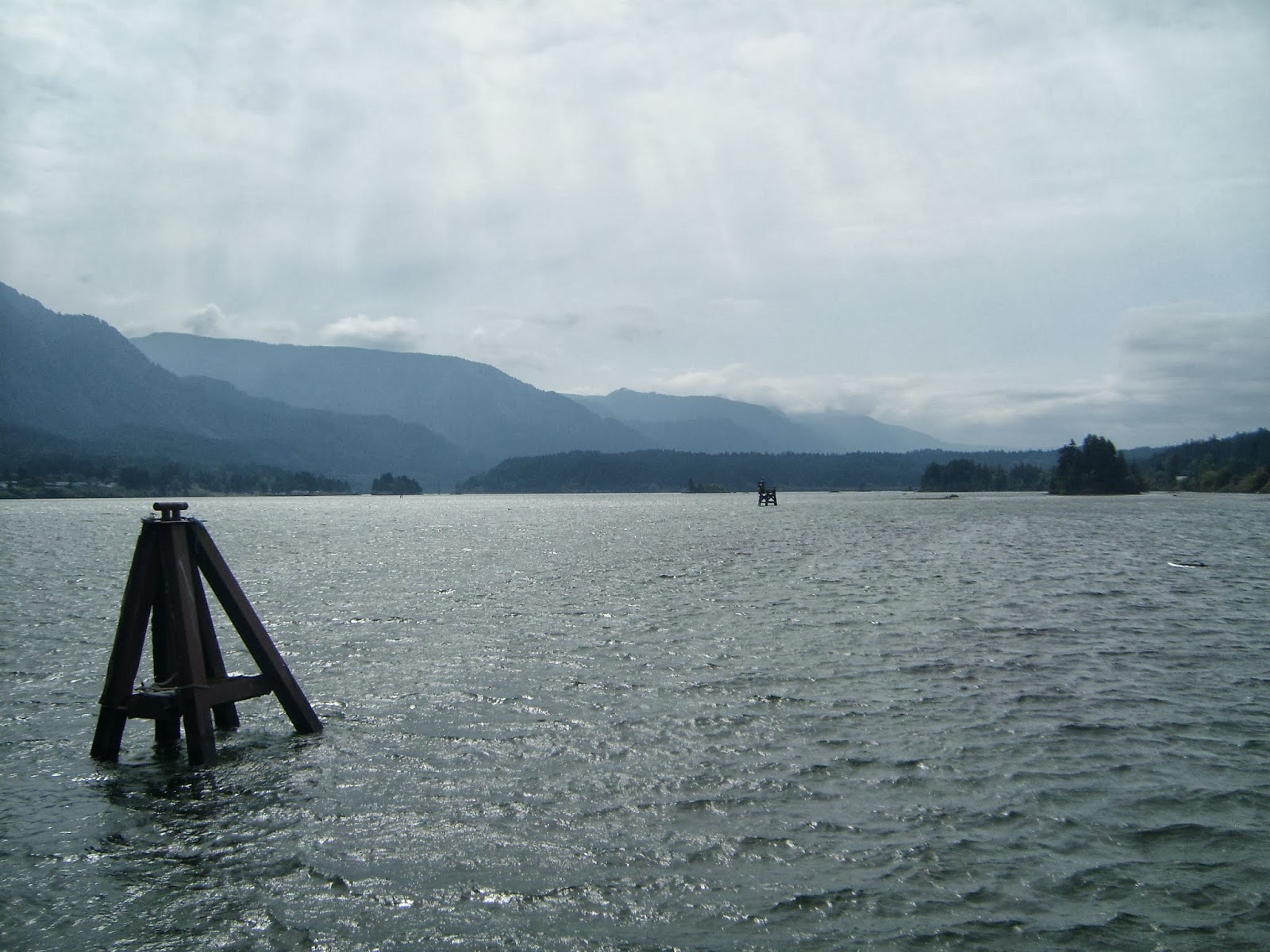
Columbia River Gorge

Add caption

Mt. Adams

Mt. Rainer from afar

Goat Rocks and Mt. Rainer

Goat Rocks (the trail is on the bottom left)

Goat Rocks and Mt. Rainer.  Can you find the trail.

Mt. Rainer

Nice lake picture

North of Snoqualmie Pass

North of Snoqualmie Pass

North of Snoqualmie Pass

North of Snoqualmie Pass

Had to ford because the bridge is gone

Stones to cross a stream

At the trail angels near Skykomish

A look inside

Northern Cascades

Meadow

Glacier Peak

Hunting yurt in the mountains

Glacier Peak

After a night of snow

On the last morning

You can see how much snow I got on my last night.

Finally!

At last!

So excited!

Putting back together the place where the trail register is.